Showing posts with label famous funerals. Show all posts

Friday, January 10, 2025

An evangelical against Christianity

I was talking with a church friend Thursday. At some point, when we were talking about culture vs. church, I mentioned how (back in 2010) I blogged about the most famous anti-Christian pop song of the late mid-20th century. We discussed how — given its anti-Christian bigotry — we couldn’t Imagine any Christian who listened to (or read) the lyrics would ever request or otherwise endorse it

After we got off the phone, I read that this same song was performed at the funeral of our 39th president, a man who had campaigned and been elected as a Southern Evangelical.

The song, of course, is “Imagine,” from the 1971 John Lennon album of the same name. It peaked at #3 on the Billboard Hot 100 chart. For those who didn’t read the earlier post, this is how John Lennon famously described his approach in a Rolling Stone interview at the time:

'Imagine' is a big hit almost everywhere -- anti-religious, anti-nationalistic, anti-conventional, anti-capitalistic, but because it is sugarcoated it is accepted. Now I understand what you have to do: Put your political message across with a little honey.

Or as freelancer Stereo Williams reflected in Billboard during the turbulent summer of 2020:

Why John Lennon’s Protest Perennial Became an Anthem For the Clueless

…It’s a song that was almost destined to turn into what it’s become today. In many ways, the track epitomizes the sanitizing of Lennon as a persona and public figure; controversial ideas couched in a likeable melody — and a more saccharine distillation of what was a very complex and contradictory oeuvre of topical music on a wide range of issues. 

This Week’s Funeral

Fast forward to this week. Like any (departed) president, James Earl Carter Jr. (1924-2024) had multiple funerals, include the most visible, his state funeral Thursday at the Washington National Cathedral, the cathedral of the Episcopal Diocese of Washington. The diocesan bishop and Carter’s “personal pastor” led the prayers.

The full program is online. The hymns were

  • Eternal Father, strong to save, aka the “Navy Hymn”
  • Amazing Grace
  • All hail the power of Jesus’ name
According to the program, the first two were performed by a choir, and the congregation was invited to sing the last hymn.

Just before the Lord’s Prayer was a song performed by Garth Brooks and Trisha Yearwood. The couple met in 1987 when both were married, and then toured and recorded songs together in the 1990s. She divorced in 1991, he divorced in 2001; they officially started dating in 2002 and married in 2005.
The program lists five verses of the song by Lennon and his wife Yoko Ono. The first two verses were
Imagine there’s no heaven
It’s easy if you try
No hell below us
Above us only sky 
Imagine all the people
Living for today...

Imagine there’s no countries
It isn’t hard to do
Nothing to kill or die for 
And no religion too 
Imagine all the people 
Living life in peace...
To my earlier criticism, with a courses from two seminaries and a master’s degree under my belt, I would add two thoughts about why this song would be anathema to any devout Christian.

First, the premise of the song is that human being are perfectible, and through hard work, we can make a perfect utopia in this life. There are all sorts of political science and sociological explanations why that will never happen (e.g., “power corrupts”), but as Christians we know than after the fall and in this world, there never has been and never will be more than one perfect human to ever walk the face of the earth.

Second, in Christian worship, this reveals a faulty eschatology, one that does not trust in God the Father (or Son or Holy Spirit), His divine revelation and promises as revealed to the human race. We know where and what perfection will look like — in the New Jerusalem revealed in Revelation — but don’t know when or exactly how it will come about. Instead, we are called to wait for God to deliver on His promises, in the time and manner of His plan.

Reaction

A few other people remarked on the incongruity of this choice, most notably those reported by the Christian Post. The best known of those mentioned is the famous Christian apologist, Catholic Bishop Robert Barron:
"Under the soaring vault of what I think is still a Christian church, they reverently intoned, 'Imagine there’s no heaven; it’s easy if you try' and 'imagine there’s no country; it isn’t hard to do. Nothing to kill or die for, and no religion too.' Vested ministers sat patiently while a hymn to atheistic humanism was sung."

"This was not only an insult to the memory of a devoutly believing Christian but also an indicator of the spinelessness of too much of established religion in our country," Barron added.

I admire Bp. Barron greatly, but presidential funerals are elaborately choreographed over years if not decades. This was no accident. This controversial song was variously reported as being one of Carter’s favorites by the Daily Mail and Fox News.

Like anyone else, President Carter had the right to pick his music — but Christian churches and pastors should draw the line. Alas, this church isn’t going to do so for an anti-Christian song, and (the reality is) probably no church (other than perhaps the decedent’s own pastor) is going to say no to a former president.

So why would Jimmy Carter do this? He was a smart man, an Annapolis grad, a former nuclear engineer. He taught Sunday school and knew his Bible, even if his Baptist beliefs moved markedly leftward after he left office.

The Nation, a famous (and historic) leftist weekly, both celebrated the choice and found earlier quotes explaining Carter’s reasons:

Carter spoke more than once about his enthusiasm for the song. He delighted in the fact that “Imagine” had become a truly international anthem. “[I]n many countries around the world—my wife and I have visited about 125 countries—you hear John Lennon’s song ‘Imagine’ used almost equally with national anthems,” the former president said in a 2006 NPR interview. “So John Lennon has had a major impact on some of the countries that are developing in the world.”

Asked by the Associated Press about his favorite Beatles song when he was attending the 2007 Toronto International Film Festival for the debut of Jonathan Demme’s documentary, Jimmy Carter Man From Plains, at the time of the premiere of Across the Universe, a film framed by the music of Lennon, Paul McCartney, George Harrison, and Ringo Starr, Carter once again mentioned Lennon’s majestic solo song.

“My favorite is ‘Imagine.’ When I go to a strange country, Cuba and other places, in some of those nations, ‘Imagine’ has become [an unofficial] national anthem. If you go to Havana, for instance, you’ll see a statue of John Lennon,” he said, referencing the memorial in Havana’s Parque John Lennon. “When we go to a folk performance or a symphony concert or to modern American music, they always play ‘Imagine,’ and it’s one of my favorites just personally. If you listen to the lyrics closely, you’ll see that it’s against religion, it’s against national boundaries, it’s against nationalism, it’s against jingoism, but the impact it has on people is profound.”

There seems to be a contradiction between this view and Carter’s stated religious beliefs.

None of us know the judgement of our own souls, let alone someone else’s. But I would hope that most devout Christian clergy would reject this song in a Christian context, if for no other reason than for its potential for misleading both Christians and non Christians about our ultimate purpose and God’s promises to the world.

Thursday, December 6, 2018

George Bush's Houston Funeral

If Wednesday’s state funeral was a quasi-government event and (consistent with other presidents) a nationally televised spectacle, it appears that today’s invitation-only service for President Bush in Houston was a cross between a traditional funeral service (at a 1500-seat Gothic-style church) and a country music concert.

The service at St. Martin’s Episcopal Church — the largest by membership of any in North America — was officiated by Rev. Dr. Russell Levenson, Jr. The rector of SMEC since 2007, Levenson also officiated the service for Barbara Bush held here on April 21, and gave the homily at President Bush's D.C. funeral yesterday.

The program is posted to the church website and summarized on the ATWNews site. Among other TV stations, the funeral was broadcast live on the website of Houston station CW69 (and also available on C-SPAN).

Funeral Music

While the D.C. funeral was Rite II, today’s Houston funeral was Rite I. Below is a summary of the music by the congregation and the St. Martin’s choir; as with other SMEC service booklets, the full hymns with harmony are included in the appendices. The worship music comprised
  • Preludes
  • Brass voluntary: “America the Beautiful”
  • “O Beautiful for Spacious Skies” (H82: 719)
  • Anthem: “This is my Country” (choir)
  • Lessons: Psalm 23, 1 Cor 12:31-13:13, John 11:21-27
  • Sequence Hymn: “Eternal Father, Strong to Save”: rather than the H40 or H82 version, this is the version from Baptist Hymnal 1991 (“Eternal father, strong to save, Whose arm doth bind the restless wave”)
  • Anthem: “Battle Hymn of the Republic” (choir)
  • Recession Hymn: “Onward, Christian Soldiers” (H82: 562), announced by Fr. Levenson to be one of the late president’s favorites
  • Organ and Brass Voluntary: Widor “Toccata”
I’ve twice attended services at St. Martin’s and even under normal circumstances the choir is impressive as their voices echo through the resonant spaces of the poured-concrete Gothic structure. However, today’s augmented choir (which appeared to more than 50) must have offered an unmatched experience for those attending. I thought the choir’s talents were best demonstrated in the Battle Hymn, with an arrangement that separated the men and women’s choir and included an a capella verse.


While the front of the church was filled with VIPs, it appeared as though in the back rows of the parish were filled with parishioners who opened their 12-page booklets and sang the closing hymn. At least among those in the front rows, nobody crossed themselves during the Apostle’s Creed (in a normal service, my experience was 5-10%).

The Concert

During the middle of the service, there was a country-western music concert by some of the late president’s favorite entertainers. Having been on funeral standby for weeks, The Oak Ridge Boys sang three voices of “Amazing Grace”, as they had for the president’s 1989 inauguration and several other occasions. However, at ages 70,75,75,and 79 (rather than in their 40s), their singing was not what it used to be.

This was followed by Reba McEntire singing a version of the Lord’s Prayer. She paced across the stage chancel while singing.

My daughter and I were surprised to see the scattered applause after the first performance (including by Jeb Bush). The decision by some to applaud seemed to give permission for everyone (including former president Bush-43) to applaud the second performance. The later choir performances were also applauded.

Heading to the Burial

When the service was over, the casket was taken outside and loaded into the hearse while the family and a select group of St. Martin’s clergy participated in the final part of the service.
The military band played the customary flourishes and Hail to the Chief. Then it played Lobe den Herren, the tune for the Lutheran hymn “Praise to the Lord, the Almighty, the King of creation!” by Joachim Neander.

The former president was buried at his library at Texas A&M. When the service was ended, the casket was loaded into a hearse to take it to a special Union Pacific train traveling from Houston to College Station.

Wednesday, December 5, 2018

Remember our last Episcopalian president

Today was the first of two funerals for George H.W. Bush (1924-2018), the 41st president whose term of office ran from 1989-1993. He was the last surviving World War II veteran to serve as president or vice president.

The 26 page service booklet for the funeral was posted by the National Cathedral and is also available here. Their 3:26 video is on YouTube while C-SPAN has a 2:26 video as well. (When the casket is being carried into the cathedral, the US Coast Guard band plays “For all the saints” at 15 minutes into C-SPAN and 1:14 into the cathedral video.) The latter has some interesting preludes (by the head organist of a Dallas Episcopal church) but the military orchestra and chorus spent more than 40 minutes on pieces that (other than America the Beautiful at the very end) I didn’t recognize.

Funeral Hymns

The liturgy was “Burial II” from the 1979 prayer book. The psalm was omitted, while the Scripture readings (from the NRSV) were Isaiah 60:1-5,18-20 and Revelation 20:1-4,6-7,23-25 (read by granddaughters) and Matthew 5:14-16 (read by the cathedral dean). The homily was by Bush's rector, Rev. Russell Levenson, Jr., who officiated the April funeral service in Houston for Barbara Bush.

It’s difficult to characterize a three hour service, so let me list the hymns:
  • "Praise my soul, the King of heaven,” 4 verses sung (in harmony) by the congregation, cathedral choir and Armed Forces Chorus
  • After the first lesson, “The King of love my shepherd is,” 6 verses by cathedral choir
  • Gospel hymn: “O god, our help in ages past,” 6 verses by military choir
  • Lord’s Prayer: the two choirs and Irish tenor Ronan Tynan
  • Before the commendation: “Eternal Father,” (the Navy version) 4 verses by the military choir for Mr. Bush (LTJG, USN, 1942-1945)
  • After the dismissal: “For all the saints,” 8 verses (unison) by all
CCM pop star Michael W. Smith also did a solo (backed by both choirs) of one of his pieces (“Friends”).

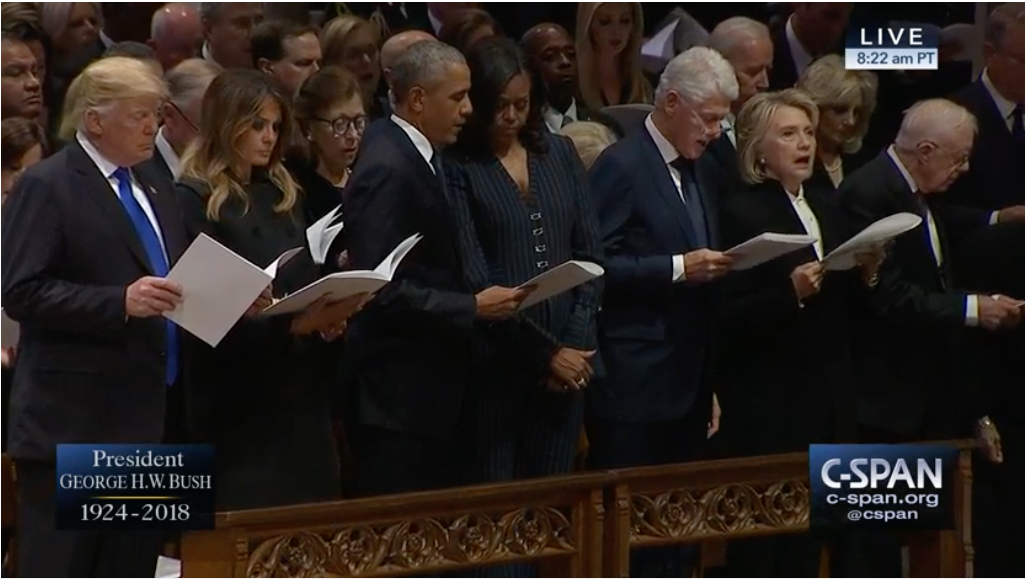
The Bush family sat on one side and the former presidents on another. During “Praise my soul,” Pres. Clinton sang the most enthusiastically, Pres. Obama next, and Mrs. Clinton sang portions; the video suggested that neither of the Carters (ages 94, 91) and the Trumps attempted to sing, nor did Mrs. Obama. On the Bush side, almost all of the children and grandchildren seemed to be singing (and some of the in-laws).

Monday's Ceremony

As is normal for a former president, Bush’s casket lay in state at the Capitol Rotunda before the funeral. When watching the ceremony Monday afternoon for the arrival of the casket, I heard three hymns played by the military band:
  • 4:28pm EST: The Navy hymn (while waiting for the casket to arrive)
  • 4:50pm EST: after Hail to the chief, the band alternated between the hymns “Fairest, Lord Jesus” and “A mighty fortress is our God” as the casket was carried up the steps
Since the latter is Martin Luther’s most famous hymn, I tend to associate it with Lutherans but I keep running into other Protestants who admire its statement of the Christian doctrine.

Update (Friday Dec 7): Bush's Pastor Describes His Faith

There were two GetReligion stories on Thursday and Friday by (and a Issues Etc. interview with) former Episcopalian GR editor Terry Mattingly, who quoted two reports on the sermon by Rev. Levenson. The first story points to a report by the New York Times which said
“My hunch is heaven, as perfect as it must be, just got a bit kinder and gentler,” the Rev. Dr. Russell J. Levenson Jr., rector of St. Martin’s, said on Wednesday in his homily. Turning to the coffin, he said: “Mr. President, mission complete. Well done, good and faithful servant. Welcome to your eternal home, where ceiling and visibility are unlimited and life goes on forever.”
When the casket arrived at the Rotunda Monday, I heard Vice President Pence explain that “ceiling and visibility unlimited” was a favorite phrase of the former naval aviator.

The later story quotes a Religion News Service story that says about the late president what any Christian would hope could be said about them
The Rev. Russell Levenson Jr., rector of St. Martin’s Episcopal Church in Houston, said the elder Bush made Levenson’s job as his pastor for almost a dozen years an easy one because of the late president’s concern more for others than for himself.
“Jesus Christ, for George Bush, was at the heart of his faith, but his was a deep faith, a generous faith, a simple faith in the best sense of the word,” said Levenson in his homily. “He knew and lived Jesus’ two greatest commandments: to love God and to love your neighbor.”

Legacies of the English State Church

This state funeral was unusual in that it was for an Episcopalian at the cathedral church of the Episcopal Diocese of Washington. The National Cathedral also host state funerals for other Christians, as it did with the 2004 funeral for Ronald Reagan (a Presbyterian) — just as Westminster Abbey did a 2013 state funeral for Lady Thatcher (a Methodist).

Bush was the last living Episcopalian president, marking the end of a run of 11 Episcopalian presidents out of the first 41. Three were founding fathers, five were among the 13 presidents from 1841-1885, and Bush was the last of the three in 20th century (that included F.D. Roosevelt and Gerald Ford).

When will the next Episcopalian become president? One proxy is the U.S. senate.

As the DC saying goes, “every senator thinks they should be president” (although in the past century, only Harding, Kennedy and Obama were senators when elected president). In today’s senate, there are only four Episcopalians (all Democrats), outnumbered by Lutherans and Mormons (6), Jews (7), Methodists and Baptists (11), Presbyterians (16) and Catholics (24). According to Wikipedia (and we all know how true it is),  Catholics are 21% of the country and Baptists 15%. The senators most visibly preening for a presidential run in 2020 or 2024 seem to be Baptist or Catholic.

I don’t expect to see another Episcopalian president in the next 30 years, as their influence has fallen dramatically. Some of it is the dilution of the English influence on America with generations of immigration; some is the shift of the American aristocracy from inherited status and wealth to one based on education. Some of it reflects the declining membership of mainline Protestantism, and Christianity more generally.

After G.H.W. Bush, there don’t seem to be a lot of prominent Republican officials who are Episcopalian. His eldest son, George W. (aka “Bush 43”) was raised Episcopalian, fell away from the church and later became a Methodist; second son, former governor and 2016 presidential candidate Jeb Bush converted to Catholicism in 1995.

As for Anglicans, 2016 presidential candidate John Kasich (governor of Ohio from 2011-2019) was raised Catholic, previously Episcopalian, and most recently reported to be attending an ACNA church. However, he would have to be considered a longshot candidate for president unless (like Bush, Ford, Nixon, Johnson, Truman, Coolidge) he was elected vice president first.

Saturday, April 21, 2018

Services for a first lady

The funeral for former first lady Barbara Bush was held today at St. Martin’s Episcopal Church in Houston, followed by burial at George H.W. Bush’s presidential library at Texas A&M.

The church is part of the Episcopal Diocese of Texas. According to Wikipedia, “It is the largest Episcopal Church in North America with nearly 9,000 members.” (Since there are no “Episcopal” churches in Canada, we assume they mean churches in the Anglican Communion).

As with similar services, it was broadcast live by C-SPAN, and available for online playback.

The blog Ponder Anew has summarized the program for the Rite I service, and the booklet is available online at an Austin TV station. Below are musical highlights, including hymns from Hymnal 1982:

Prelude music
  • “Nearer my God to thee”
  • “My country, ’tis of thee”
  • Hymn 390: “Praise to the Lord”; Tune: Lobe den Herren
During the service
  • After the 1st Lesson: “In the Garden”
  • Sequence Hymn 671: “Amazing Grace”; Tune: New Britain (V1-2 before, V3-4 afterwards)
  • After the Homily: “The Holy City"
  • Hymn 376: “Joyful, Joyful, We Adore Thee”; Tune: Ode to Joy
Postlude
  • “Solemn Procession” (Richard Strauss)
A few comments. On Amazing Grace, only Newton’s original four verses are used, not the later epilog (“When we’ve been there 10,000 years”). Except for Amazing Grace, this is not standard American funeral music — the two other tunes are ones that could be sung during ordinary time or any festal season.

Finally, this seems like an unusually brief amount of music for such a grand service in such a large church with a large choir. The opening hymn has a descant written in Hymnal 1982; however, the descant does not appear in the service booklets held by the congregation in the C-SPAN video, nor could I hear it. It is not an English descant, but I think any major English choir would have sung a descant: New English Hymnal has AB Smith’s while the Oxford Book of Descants has Oxley’s.

In fact, it’s almost an anti-Colonial service, opening with a 17th century German hymn. It is followed by the text from an English abolitionist that is far more popular at American funerals than English ones (where it is only #5). It concludes with Beethoven’s most famous tune with an American text, and a postlude by a German agnostic (if not atheist).

Update: On the Facebook group for church musicians, several noted that St. Martin’s has consistently been “low church.” While this term means different things to different people, it tends to mean more Protestant and less Catholic — i.e., consistent with not using English hymns or fancy descants.


This picture shows Barbara and George Bush with their kids at St. Martin’s.
Source: Barbara Bush’s funeral program.


Sunday, February 21, 2016

Funeral for a Catholic traditionalist

Like many American Christians, I was surprised and shocked by the Feb. 13 announcement of the death of Justice Antonin Scalia. We were traveling during the funeral, and so caught the rebroadcast on C-SPAN after we got home.

Some 3,000 attended the service at America’s largest Catholic church, the Basilica of the National Shrine of the Immaculate Conception. In the funeral homily, the celebrant — his son Rev. Paul Scalia — described his father’s faith:
God blessed Dad with a deep Catholic faith: The conviction that Christ's presence and power continue in the world today through His body, the Church. He loved the clarity and coherence of the church's teachings. He treasured the church's ceremonies, especially the beauty of her ancient worship. He trusted the power of her sacraments as the means of salvation as Christ working within him for his salvation.
The homily included a mixture of theology and eulogy, consistent with a letter by Justice Scalia, as quoted by his son:
Even when the deceased was an admirable person, indeed, especially when the deceased was an admirable person, praise for his virtues can cause us to forget that we are praying for, and giving thanks for, God’s inexplicable mercy to a sinner.
According to Donald Cardinal Wuerl, the services were in keeping with the wishes of his widow and his family.  The program was posted at several locations, including the Corpus Christi Watershed blog. The readings were Wisdom 3:1-9, Psalm 23, Romans 5:5-11, and Matthew 11: 25-30 with the texts (not surprisingly) taken from the New American Standard.

Not all the music was listed in the program. According to one of the Catholic musicians at the Church Music Association of America, the musical pieces were:
  • Hymn "O God Our Help in Ages Past"
  • Collect is sung by Father Scalia
  • Psalm 23:1-6: sung by the National Shrine choir
  • Verse: sung by the National Shrine choir
  • Offertory motet: Beati quorum via (Stanford)
  • Preface dialogue: chanted
  • Sanctus: XVIII (chanted, with organ)
  • Memorial Acclamation: When... (chanted, with organ)
  • Amen (chanted, with organ)
  • Our Father (chanted sonorously by all present)
  • Peace Dialogue (chanted)
  • Agnus Dei - Victoria, Missa Quarti Toni National Shrine choir
  • A treble schola chants the Communion verse "Lux Aeterna" according to the Graduale Romanum
  • Communion Hymn: Jesus, My Lord, My God, My All (Faber)
  • Communion motets: Franck's Panis Angelicus, Mozart's Ave Verum
  • Post-communion dialogue: chanted
  • In Paradisum: English, sung by the National Shrine choir
  • Recessional: O God Beyond All Praising (Holst)
I must say that I only recognized the processional hymn, the first communion motet and the Holst tune for the recessional (but not its 1982 text). However, the chant for the Lord’s Prayer seemed to share a common origin with the “very ancient” Anglican chant for this prayer (H40: 722).

Communion was administered in one kind. The bulletin quoted a 1996 USCCB policy that discouraged non-Catholics from coming to communion — except for a few specific denominations (including Orthodox Christians) who were allowed but “urged to respect the discipline of their own Churches.”

Scalia was (not surprisingly) a liturgical traditionalist, with a preference for the Latin mass. However, the plainchant in the first part of the service (what we Anglicans call the liturgy of the word) seem to be taken from the modernized 21st century American Catholic liturgy — with the introit and other chants typical of a modern American RCC parish.

I was not the only one struck with the modernity of the service. Catholic organist and blogger Jeff Ostrowski wrote:
It’s difficult to understand why the Mass was Ordinary Form since Justice Scalia was known to attend the Extraordinary Form exclusively. Moreover, while the musical selections were (generally speaking) fine, they were nothing compared to Requiem settings by Victoria, Guerrero, Morales, and so forth. Perhaps the problem is me. I just find the traditional Requiem so powerful & consoling, anything else can’t help but fall short.
While many of us liturgists and church musicians have our preferences for our personal church services, it’s important to put it in perspective: there’s nothing in the choice of the form that would make one iota of difference in the disposition of our eternal soul. If the service was consistent with the family’s wishes — perhaps to make it more approachable to the nation’s 70 million Catholics — then their liturgical choices must be respected and honored.

Antonin Gregory Scalia (1936-2016): Requiescat in pace.

Thursday, April 18, 2013

A funeral for a Baroness

Wednesday was the funeral for Margaret Thatcher (1925-2013), Britain’s second greatest prime minister of the 20th Century (after Churchill), who in her three consecutive terms transformed the British economy and society.

The service for Baroness Thatcher of Kesteven was held at St. Paul’s Cathedral, which lacks the official history of Westminster Abbey but makes up for it with architectural grandeur and scope (having been for centuries Britain’s tallest building). I couldn’t watch live, but it was covered by her old ally the Telegraph and her nemesis the Guardian (among others).

Since her death, I’ve been reading a wonderful biography by American Claire Berlinski, entitled There is No Alternative: Why Margaret Thatcher Matters. It credits her Methodist upbringing (and the influence of her father) for her great political success.

I don’t know much about English Methodists — other than the Wesley family and their hymns — but the order of service posted at the Telegraph and the St. Paul’s website seems very Church of England to me. The words to the hymns were very familiar to my ECUSA-raised upbringing (although the tunes were not).

The headline on the Telegraph service commentary termed it “a miraculous pairing of words and music.” As Christopher Howse wrote:
From the moment her coffin was met at St Clement Danes with the words, “We who are baptised in the death of Christ,” the topic was something universal: death. This was not divisive but, in the words of the Bishop of London, “the common destiny of all human beings”. It was, yesterday, as if the millions watching were following a stage tragedy. The difference was that this was a true story, and the tragic flaw of the heroine was not a moral failing but mortality itself.

The Church of England service emphasised two things: the reality of death, with no demurring, and the hope of resurrection. “The days of man are but grass,” read Prebendary Rose Hudson-Wilkin. “For as soon as the wind goeth over it, it is gone.” Left at that, it would be no more than Hadrian’s sad farewell to the soul: “Animula, vagula, blandula.” But it was not left at that. From deep, dim waters it strove upwards towards the light.

“Let not your heart be troubled,” the Prime Minister read from the Gospel of St John. “I go to prepare a place for you.” Those were words of Jesus, and, in the passage read, Thomas usefully responded, “Lord, we know not whither thou goest.” Nothing could rub in more sorely that we cannot see beyond the dark and narrow gates of death.
The text was from the Authorized Version (King James for us Yankees), including the Lord’s Prayer and a reading by her granddaughter of Ephesians 6: 10-18.

The opening sentences sung by the choir include these three (or at least two) very familiar passages, to a setting by William Croft:
I am the resurrection and the life, saith the Lord: he that believeth in me, though he were dead, yet shall he live: and whosoever liveth and believeth in me shall never die.
John 11. 25, 26

I know that my Redeemer liveth, and that he shall stand at the latter day upon the earth. And though after my skin worms destroy this body, yet in my flesh shall I see God: whom I shall see for myself, and mine eyes shall behold, and not another.
Job 19. 25-27

We brought nothing into this world, and it is certain we can carry nothing out. The Lord gave, and the Lord hath taken away: blessed be the name of the Lord.
1 Timothy 6. 7 and Job 1. 21
Other music included “How lovely is thy dwelling place,” an adaptation of Psalm 84 that’s one of my favorite songs from Brahms’s German Requiem.

The first congregation hymn was “He who would valiant be,” adapted by Dearmer and Vaughan Williams for The English Hymnal from text by John Bunyan (the great Puritan author) and an English folk tune. From The Cyberhymnal description, it seems an odd hymn to put in a CoE hymnal:
Words: John Bun­yan, Pil­grim’s Prog­ress, 1684; mo­di­fied by Per­cy Dear­mer in The Eng­lish Hym­nal (Lon­don: Ox­ford Un­i­ver­si­ty Press, 1906). Bun­yan wrote these words dur­ing his 12-year pri­son sent­ence for re­fus­ing to con­form to the of­fi­cial state church.
The “official state church” in this case was the 150-year-old CoE, which was too Anglo-Catholic for the Puritans and many others of the severe (or seriously) reformed faith. So this hymn in a 20th century Anglican hymnal celebrates defiance of the 17th century Anglican church.

Lady Thatcher’s funeral used the TEH version (#402) with the tune to Monks Gate, while H40 (#563) lists St. Dunstan’s and H82 (in a rare improvement) includes both tunes (#565 and #564 respectively), albeit without harmony for the former.

In a similar vein, the final congregation hymn was “Love Divine” by Charles Wesley. Raised on H40, the version to Hyfrydol (H40: #479) had very strong resonance with me, even before Mrs. Nine and I sang it at our wedding.

However, apparently that’s not the tune used by the CoE. TEH (#437) lists Moriah, while Songs of Praise, Enlarged Edition (#573) has the Welsh Moriah and the English Exile. Among CoE hymnals, only in the New English Hymnal (#408) do we see Blaenwern, the 1905 tune by William Rowlands used at Lady Thatcher’s funeral.

Other than the 1905 date, I haven’t found much about Blaenwern, perhaps because I only have a limited collection of books on English hymns. Ian Bradley lists five tunes, including three no longer used: the Purcell tune Westminster that Wesley favored, Love Divine by John Stainer (in the 1889 Hymns A&M and NEH), and Airedale by Charles Stanford. Bradley continues
Nowadays the hymn is generally sung to one of two equally majestic Welsh tunes: Hyfrydol by Rowland Huw Pritchard (1811-57), a loomtender’s assistant in the Weslh Flannel Manufacturing Company’s mills at Holywell; and Balenwern by William Penfro Rowlands (1860-1937).
One last note on Blaenwern: it’s the tune used with these lyrics at the wedding of the Queen’s grandson to Kate Middleton held two years earlier — and two miles away — at Westminster Abbey.

The service concluded with the Nunc Dimittis (in English) from Stanford’s Evening Service in G. Again, the words are very familiar but the tune is not; H40 has seven settings of the Nunc Dimittis, but none match the Stanford setting. By the end of the service, I would have would have heard many familiar texts, but (except for Brahms) not to the expected melodies.

Interestingly, the only overlap between Lady Thatcher’s service and the 2007 service for (Episcopalian) Gerald Ford is the Brahams — “How Lovely Is Thy Dwelling Place” (in English) from the German Requiem.

I won’t be having a state funeral, but perhaps my friends and family will host one at my local parish church many decades hence. I feel I can’t go wrong with these examples: the Brahms and “Love divine” would top my requests for my own funeral (assuming our local choir can handle it). My third request would be “The Lord is my Shepherd” (Psalm 23) from Rutter’s Requiem; we did the psalm for my dad’s funeral, but the choir at his church wasn’t up for the Rutter setting on such short notice. In general, I’m not a big Rutter fan, but this piece is the most haunting setting I’ve ever heard of this text.