Saturday, December 22, 2007

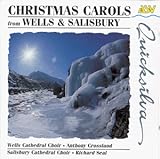
My latest Christmas album


When visiting friends last weekend, our (English) host showed me a Christmas CD of which he knew I'd approve. And I did. So I bought it from Amazon. It seems to be out of print, so I bought it used, and it arrived Friday.

A major attraction was that it contained performances by two leading English cathedral choirs, from Wells and Salisbury. The recordings were made in 1978 and 1987, respectively, although the latter says it was a benefit concert (for cathedral restoration) "in the presence of the H.R.H The Prince of Wales." Apparently HRH has made restoring Salisbury Cathedral a personal priority.

Whether through the original scheduling or the culling of duplicates, most of the traditional carols are on the Wells part of the CD, but I did very much like the Salisbury rendition of “In the Bleak Winter.” The texture of several of the Wells carols (notably “Once in Royal David’s City” and “Coventry Carol”) show how a choir can vary and build emotional intensity on a simple carol in a way that congregation singing cannot.

I have 29 Christmas albums on my MP3 player. Most recordings of Christmas carols seem to be schmaltzy commercial versions by secular musicians, so it’s nice to hear the traditional songs of Christian worship interpreted by (Anglican) church choirs.

Friday, December 21, 2007

The original KJV

Most American Christians know that the King James bible was the first officially authorized translation of the Bible into English — as authorized by King James (and thus called the “Authorized Version” in England).

The King James was first released in 1611. It followed the earlier (unauthorized) translations by John Wycliffe and followers in the 14th century, and Tyndale’s Luther-inspired translation of the New Testament in 1524.

The King James Version was read in most churches until the late 20th century. In the past two decades has become popular as a computer text (first on PCs, now on the Internet) because unlike the NIV and RSV, its copyright has long since expired and is now in the public domain.

This oft-read KJV is thought of as the version Authorized by James, but the reality is that modern Americans have been using the 1769 edition. If the 1769 seems archaic, the 1611 (in Middle English) would be incomprehensible.

For those who want to understand the history of the 1611 edition and all the changes up to 1769, New Zealand Bible scholar David Norton has published A Textual History of the King James Bible. It is the definitive treatment of the text of the KJV, rather than earlier books that focused on biographies of its editors.

Norton has also re-edited and re-released the 1611 edition (under the cryptic name ) (but with modern spelling) for those who want to study from the earlier edition. Cambridge University Press has a dedicated website that explains more about the project.

Thanks to Rev. Peter Toon for summarizing the differences between the 1611 and 1789 editions, and the importance of the original.

Thursday, December 20, 2007

A Catholic view on hymnody

Blogging about hymns is a bit of an esoteric habit. I’ve mentioned a Lutheran blog by Josh Osbun (alas on hiatus) and a COE blogby Cathy Osborne — and of course the occasional KFUO radio session — but otherwise there isn’t much out there.

Today, following the link from GetReligion to Amy Welborn’s blog to her blogroll, I found a blog on Catholic hymns entitled “Hymnography Unbound,” written by “Kathy” of Washington, DC.
I don’t know to what degree these two blogs will overlap in their readership. The author is concerned about Catholics avoiding use of inappropriate Protestant hymns by Germans, clearly not a concern here. (I suspect we share some concerns about extreme Calvinist interpretations).

However, I liked her posting about what people look for in hymns (traditional, singable tunes), and she’s written a lot about Latin hymnody. The blog has both a longer history and higher monthly output than the ones I cite to the right, but I still haven't decided whether it will turn out to be a longterm favorite.

I have to admit, I'm the tyro here. “Kathy” writes hymns as an avocation, Osborne has a classical education and is fluent in Latin, and Osbun is training to be an ordained minister. So bear with me as I share my personal observations from a American Anglo-Catholic lay perspective.

Tuesday, December 18, 2007

Happy 300th birthday Mr. W.

On the Anglican-music mailing list (no relation) I saw a reminder that today is the 300th anniversary of the birth of Charles Wesley, the lyricists for more than 5,000 hymns. The best known of these are "Hark, the herald angels sing" and "Christ the Lord Is Risen Today." My personal favorites would be "Love Divine, All Loves Excelling" (set to Rowland Prichard’s Hyfrydol) and "O for a Thousand Tongues to Sing" (which my boyhood choir director liked to have us sing to Land of Rest).

To mark the occasion, the public radio show Pipedreams did a complete episode on the Wesley musicians: Charles Wesley, his son Samuel and his grandson Samuel Sebastian. I have not had a chance to listen the show (available online), but presumably it does not spend a lot of time on John Wesley, founder of the Methodist church.

This evening, Boston’s Old North Church (in the Episcopal Diocese of Massachusetts, alas) is hosting a commemoration of Charles Wesley's 300th birthday. This is the actual church where he preached back in 1735.

I’m sorry that I can’t make it, but happy birthday, Charles.

Monday, December 17, 2007

Traditional worship making a comeback

Today’s GetReligion includes an interesting posting by Mollie Ziegler Hemingway, commenting on a US News story that claims there’s a movement towards returning to traditional worship in Catholic, Muslim and Jewish faiths.

After commenting on the story and the trend, Mollie notes the superficial nature of trying to cover so many faiths in one story. Although not a Lutheran, Mollie is a member of the LCMS, the moderately conservative Lutheran branch whose work with KFUO I often praise here. Although I’m not a Lutheran, Mollie is the GetReligion whose worship attitudes I feel most comfortable (particularly since TMatt went Orthodox), as demonstrated by today’s quote:
But as someone who worships liturgically and grew up worshiping liturgically, it seems to me that a lot of this “movement” isn’t so much about returning as staying put. Confessional Lutherans will keep worshiping the way we do even when this “return to tradition” fad gets passed to wherever the leftover WWJD bracelets are being hidden. It’s funny to me that those of us that don’t change with the times every few years only get coverage because apparently a fad is guiding people in our direction.
In addition to Mollie’s points, the first thing that grabbed me about the article was the backlash by liberals against the trend towards the Tridentine mass in the Catholic church:
Some liberal Catholic clergy are completely skeptical about the scope and meaning of the traditionalist turn. "It's more hype than reality," says the Rev. Thomas Reese, a Jesuit priest and political scientist at Georgetown's Woodstock Theological Center. Reese thinks the church should focus less on the Latin mass than on the three things that draw most churchgoers: "good preaching, good music, and a welcoming community."
which was partially be rebutted by a Catholic neocon:
But Sister Patricia Wittberg, a sociologist at Indiana University-Purdue University in Indianapolis, sees more substance in the new traditionalism. "I think churches that can articulate what they do and what they stand for tend to grow better." To that extent, she says, the conservative turn in the church makes sense. But she points out that there are two kinds of conservatives. "One group," she says, "would like to take things back to the [16th-century Counter-Reformation] Council of Trent, but I don't think the future's with them. I think the future is with a group that is interested in reviving the old stuff and traditions in a creative way. Sisters in traditional orders may wear habits, but they often live in coed communities."
Although Anglicans were not mentioned, it was interesting to read about an evangelical Protestant church adopting a liturgical calendar and (occasionally) saying the Nicene Creed.

This seems to go against another article by TMatt, in this case in his paid job as a religion columnist. (Hat tip to innocent as doves). Entitled “Hitting the 500-year wall,” he speculates what as to what will come next on the 500 year cycle after the Crucifixion, the fall of Rome, the Great Schism and the Reformation. The expert he quotes seems to be promoting some form of postmodern Christianity (aka “emerging Christianity”), but I wonder if the real trend (as evidenced by the Anglican wars) of having Christianity led over by the African church — or, as the article quoted by David Virtue today puts it:
African Christians regard their Christian faith as their whole life and not just a part-time activity, said the head of the World Council of Churches on Sunday. The Rev. Dr. Samuel Kobia’s response was to a question posed by Dean Samuel T. Lloyd III of the famed Washington National Cathedral about why Christianity was exploding in Africa whereas Christian denominations in the United States have been reporting declining membership.

“Religion is seen not as a part-time occupation, but it permeates the whole life,” WCC General Secretary Kobia answered. “There are many Africans therefore that think their future will be much more hopeful if they embrace the Gospel of Jesus Christ.

It is projected that by 2025 there will be 700 million African Christians in the world – a phenomenal increase from about 10 million in the early 20th century.

Current Anglican Primate of the Church of Nigeria, Archbishop Peter Akinola, for example, has more people in his church pew on any given Sunday than all of the Anglican churches in the United States and Europe combined, according to Kobia.
The collapse of 2,000 years of European Christianity would certainly be a big deal. Alas, from my narrow personal tastes, it might also mean a dying out of Gregorian Chant and other forms of traditional worship derived from the medieval Roman church: let’s hope it doesn’t come to that.