Saturday, December 29, 2007

Not my favorite hymnal

We are traveling to visit family and friends during the 12 Days of Christmas, away from our home parish. For Christmas Day services, we went to former PECUSA parish that's now continuing Anglican under Abp. Gregory Venables. Alas, before they fled PECUSA they had switched to the 1979 BCP and 1982 Hymnal. The Christmas service gave me several reminders of why I dislike the 1982 Hymnal.

The first thing I noticed was the musical typography. When I tried to sing the carols, the 1982 Hymnal used very small note symbols that were impossible to read in the low light of the church. I don't have my library of hymnals in my suitcase, but I checked the 1940 Hymnal at our relative's house and the staff spacing appeared to be 20-25% bigger. (I will have to lay them side-by-side when I get home).

The other problem was the politically correct Christmas carols. Under Hymn #87, Charles Wesley’s Christmas megahit has been further mangled:
Hail, the heaven-born Prince of Peace:
hail, the Sun of Righteousness.
Light and life to all he brings,
risen with healing in his wings.
Mild he lays his glory by,
born that man we no more may die,
born to raise the sons of us from the earth,
born to give them us second birth.
Hark, the herald-angels sing
glory to the new-born King.
In searching for the exact PC words, I found an Englishwoman (and poet) who objected to this abomination as grocery story background music. She should count her blessings: at least in England grocery stores play Christ-mas carols.

The next mangled hymn was in the second verse of Isaac Watts' all-time favorite, Joy to the World! As printed in the 1982 hymnal, the m-bomb has been edited out:
Joy to the world! the Savior reigns;
let men their us our songs employ,
while fields and floods, rocks, hills and plains
repeat the sounding joy,
repeat, repeat the sounding joy.
This still conveys the original sense of praising God, but to me the imperative seems much weaker since it is directed to the first person plural.

I had forgotten about this bowdlerization of traditional carols, and thus was not prepared to belt out the correct wording when the time came. The congregation seemed unsure as to whether to use the old or the new words, but obviously a generation of Americans is being raised to assume that the PC words are the correct way to sing these hymns.

From Tuesday's selection of six hymns, I had assumed the pattern was that the PECUSA hymnal committee would not change the first verse of a hymn because it was too visible, but were tinkering with the second verses. However, in the final hymn — O Little Town of Bethlehem — the dreaded m-word made it through intact. Verse 2 of Hymn #79 reports
For Christ is born of Mary;
and gathered all above,
while mortals sleep, the angels keep
their watch of wondering love.
O morning stars, together
proclaim the holy birth!
and praises sing to God the King,
and peace to men on earth.
I don't know why this use of the m-word survived but others did not.

All told, this reconfirms my opinion that Hymnal 1982 is an interesting supplemental book, but dubious as a primary pew hymnal.

Tuesday, December 25, 2007

Mary had a baby

December is the month when Anglicans spend a lot of time talking and thinking about the Virgin Mary, culminating with the celebration of Christmas Day.

Mary's place in Christian history begins with the Annunciation, celebrated in the church calendar in March. This gives us the best Marian hymn of the entire 1940 Hymnal, Hymn #117. The Annunciation is recounted by Luke’s Gospel, in a passage that was a recent recommended reading from from my subscription to the Bible Gateway verse-of-the-day feed,
And the angel said to her, "Do not be afraid, Mary, for you have found favor with God. And behold, you will conceive in your womb and bear a son, and you shall call his name Jesus. He will be great and will be called the Son of the Most High. And the Lord God will give to him the throne of his father David, and he will reign over the house of Jacob forever, and of his kingdom there will be no end." (ESV, Luke 1:30-33)
The Orthodox make a big deal about the Theotokos (“Mother of God”) while Catholics have a strong Marian worship tradition that include a Mary altar, and recitations of “Hail Mary.” My sense is that the Anglicans are somewhere between the Orthodox and Catholics at one end, and the bulk of Protestants at the other.

However, when it comes to Mary the Anglo-Catholics seem to be closer to the Roman Catholic Church than to Reformed or Calvinist traditions or even some forms of Lutheranism. If you visit an Anglo-Catholic parish named “St. Mary,” you would expect this even more so.

Sure enough, during the service at Hollywood’s St. Mary of the Angels earlier this month, there were two distinctly Marian references. One is The Angelus which (according to the pew service booklet) comes at the end of every service at St. Mary’s. I didn’t take the booklet (and thus the exact words) with me, but I know it did include three Hail Marys. The other Marian reference was the hymn “Ye Who Own the Faith of Jesus,” which in its typesetting looks like it was from TEH or Hymns A&M. Each refrain “Hail Mary, hail Mary, hail Mary, full of grace.”

Together, the 14 (3+11) refrains of Hail Mary suggest that St. Mary’s is on the Catholic end of the Anglo-Catholic scale.

Interestingly, Mary is less prominent in traditional carols for these 5-6 weeks of the liturgical calendar. Most of the Advent and (Christian) Christmas carols talk about the coming of Jesus — or, as the billboards say, “Jesus is the reason for the season.” But the child-bearer obviously figures in some of these tellings. In the 1940 Hymnal, a handful of the December hymns reference the Virgin birth: 17, 18, 20, and 41. For some reason, it seems like the oldest hymns are the most devout in their Marian emphasis, as with this most succinct statement (translated for Hymn 18) of the 8th century hymn by St. Germanus: “Behold, a virgin mother brings forth God’s only Son.” Other hymns merely refer to “mother Mary.”

In an odd coincidence, this month as brought two interesting surveys on Christian belief on the Virgin Mary. First blogger Anne Coletta quoted the Spectator (with amplification from a British blogger) which asked leading British Christians the simple question ‘Do you believe in the Virgin Birth of Jesus Christ?’ Apparently, some Church of England clergy do not.

Meanwhile 75% of 1,005 American adults surveyed this month by David Barna (quoted by David Virtue) believe the virgin birth to be literal fact. Barna writes:
Of the six Bible stories examined in the survey, this story was the most widely accepted.

Mary’s virgin birth was accepted as literally true by two-thirds of upscale adults (66%) "Upscale" people are those who have completed a four-year college degree and have an annual household income of $75,000 or more.
In a follow up to the Spectator interviews, the leader of the Anglican Communion was interviewed live by Simon Mayo of the BBC on Dec. 19. As transcribed by The Telegraph, he was (as always) somewhat equivocal:
Archbishop of Canterbury: We know his mother's name was Mary, that's one of the things all the gospels agree about, and the two gospels that tell the story have the story of the virgin birth and that's something I'm committed to as part of what I've inherited.

Simon Mayo: You were a prominent part of a Spectator survey in the current issue which headlined' Do you believe in the virgin birth?' there are some people in this survey who would say they were Christian who don't have a problem if you don't believe in the Virgin birth;' how important it is it to believe in that bit?

Archbishop of Canterbury: I don't want to set it as a kind of hurdle that people have to get over before they, you know, be signed up;, but I think quite a few people that as time goes on, they get a sense, a deeper sense of what the virgin birth is about. I would say that of myself. About thirty years ago I might have said I wasn't too fussed about it - now I see it much more as dovetailing with the rest of what I believe about the story and yes.
Contrast that to the unequivocal answers in the Spectator survey by Bishop of Rochester Michael Nazir-Ali (one of Rowan Williams' most prominent conservative critics in the CoE) and also by Rev. Nicky Gumbel, developer of the Alpha Course.

Of course, Abp. Williams' in the BBC interview got the most headlines for saying the three wise men (and thus presumably the Epiphany) were a legend, but that’s another story.

Saturday, December 22, 2007

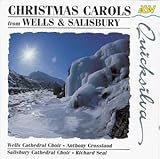
My latest Christmas album


When visiting friends last weekend, our (English) host showed me a Christmas CD of which he knew I'd approve. And I did. So I bought it from Amazon. It seems to be out of print, so I bought it used, and it arrived Friday.

A major attraction was that it contained performances by two leading English cathedral choirs, from Wells and Salisbury. The recordings were made in 1978 and 1987, respectively, although the latter says it was a benefit concert (for cathedral restoration) "in the presence of the H.R.H The Prince of Wales." Apparently HRH has made restoring Salisbury Cathedral a personal priority.

Whether through the original scheduling or the culling of duplicates, most of the traditional carols are on the Wells part of the CD, but I did very much like the Salisbury rendition of “In the Bleak Winter.” The texture of several of the Wells carols (notably “Once in Royal David’s City” and “Coventry Carol”) show how a choir can vary and build emotional intensity on a simple carol in a way that congregation singing cannot.

I have 29 Christmas albums on my MP3 player. Most recordings of Christmas carols seem to be schmaltzy commercial versions by secular musicians, so it’s nice to hear the traditional songs of Christian worship interpreted by (Anglican) church choirs.

Friday, December 21, 2007

The original KJV

Most American Christians know that the King James bible was the first officially authorized translation of the Bible into English — as authorized by King James (and thus called the “Authorized Version” in England).

The King James was first released in 1611. It followed the earlier (unauthorized) translations by John Wycliffe and followers in the 14th century, and Tyndale’s Luther-inspired translation of the New Testament in 1524.

The King James Version was read in most churches until the late 20th century. In the past two decades has become popular as a computer text (first on PCs, now on the Internet) because unlike the NIV and RSV, its copyright has long since expired and is now in the public domain.

This oft-read KJV is thought of as the version Authorized by James, but the reality is that modern Americans have been using the 1769 edition. If the 1769 seems archaic, the 1611 (in Middle English) would be incomprehensible.

For those who want to understand the history of the 1611 edition and all the changes up to 1769, New Zealand Bible scholar David Norton has published A Textual History of the King James Bible. It is the definitive treatment of the text of the KJV, rather than earlier books that focused on biographies of its editors.

Norton has also re-edited and re-released the 1611 edition (under the cryptic name ) (but with modern spelling) for those who want to study from the earlier edition. Cambridge University Press has a dedicated website that explains more about the project.

Thanks to Rev. Peter Toon for summarizing the differences between the 1611 and 1789 editions, and the importance of the original.

Thursday, December 20, 2007

A Catholic view on hymnody

Blogging about hymns is a bit of an esoteric habit. I’ve mentioned a Lutheran blog by Josh Osbun (alas on hiatus) and a COE blogby Cathy Osborne — and of course the occasional KFUO radio session — but otherwise there isn’t much out there.

Today, following the link from GetReligion to Amy Welborn’s blog to her blogroll, I found a blog on Catholic hymns entitled “Hymnography Unbound,” written by “Kathy” of Washington, DC.
I don’t know to what degree these two blogs will overlap in their readership. The author is concerned about Catholics avoiding use of inappropriate Protestant hymns by Germans, clearly not a concern here. (I suspect we share some concerns about extreme Calvinist interpretations).

However, I liked her posting about what people look for in hymns (traditional, singable tunes), and she’s written a lot about Latin hymnody. The blog has both a longer history and higher monthly output than the ones I cite to the right, but I still haven't decided whether it will turn out to be a longterm favorite.

I have to admit, I'm the tyro here. “Kathy” writes hymns as an avocation, Osborne has a classical education and is fluent in Latin, and Osbun is training to be an ordained minister. So bear with me as I share my personal observations from a American Anglo-Catholic lay perspective.